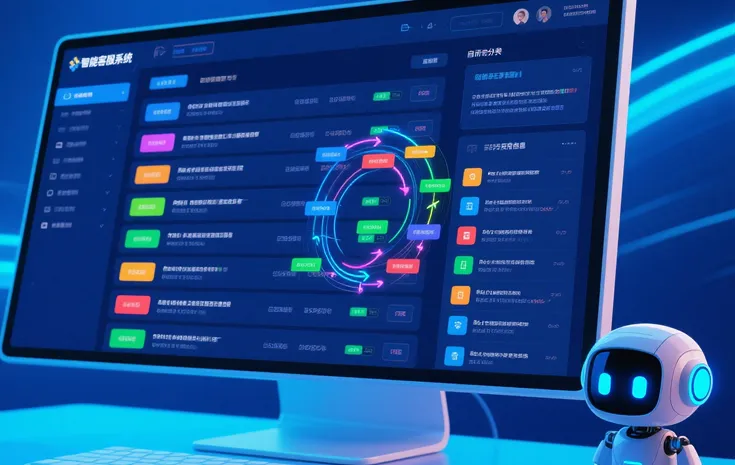
Intelligent customer service (AI + Customer Service) is applied in online customer service (Online Customer Service) and offline counter clerk (Offline Counter Clerk) scenarios. It leverages artificial intelligence technologies such as natural language processing (NLP), machine learning, and deep learning to simulate manual service processes and engage in dialogue with customers. It can understand customer questions, provide accurate and useful answers based on preset rules and algorithms, and combine cutting-edge technologies such as the Internet of Things and automated control to offer customers an efficient and precise processing experience for core functions such as identity verification, information inquiry, business handling, and transaction settlement. Intelligent customer service breaks the limitations of traditional services, achieving 7×24 uninterrupted service.

Application scenarios

Application scenarios

01

Accurate Answers to Policy and Business Inquiries

Intelligent customer service can quickly and accurately answer customer inquiries about various policies and businesses. For complex policy documents, intelligent customer service can interpret them in easy-to-understand language. Especially when the inquirer's questions are combined with their own individual circumstances, intelligent customer service can think like human customer service and provide personalized responses to the inquirer.

Accurate Answers to Policy and Business Inquiries

02

Handling and Classification of Customer Complaints

Regarding customer complaint information, whether it's about the department's service attitude, work efficiency, or other related issues. Intelligent customer service can handle them with consistent service standards and attitudes. This avoids dissatisfaction from complainants due to individual differences in customer service personnel's experience, attitude, and professionalism. At the same time, intelligent customer service can automatically classify complaint content and forward it to the corresponding departments for follow-up processing.

Handling and Classification of Customer Complaints

03

Guidance, appointment, pre-examination, and acceptance for business processing

Firstly, the intelligent customer service can provide customers with detailed process guidance for the business they need to handle. This includes: the forms that need to be filled out, the steps to be taken, and precautions. Secondly, before processing the business, the intelligent customer service can conduct a pre-examination of the application materials submitted by the customer. The pre-examination content includes: whether the materials are complete, whether the format is correct, and even promptly informing the applicant of any content that needs to be supplemented or modified. For matters that only require online processing, after the materials pass the pre-examination, the intelligent customer service can directly accept them or forward them to the relevant department for follow-up processing. For business that requires offline acceptance, the intelligent customer service can also help customers schedule an appropriate processing time and location.


Guidance, appointment, pre-examination, and acceptance for business processing

Advantage Highlights

Advantage Highlights

High cost-effectiveness

High cost-effectiveness

Intelligent customer service can significantly reduce enterprise manual customer service costs, including expenses related to recruitment, training, and compensation of customer service personnel.

Service Quality Improvement

Service Quality Improvement

Emphasizes that intelligent customer service can provide consistently high-quality service, avoiding fluctuations in service quality caused by factors such as fatigue and emotions in human customer service. Through accurate and rapid responses, it improves the customer issue resolution rate and enhances customer satisfaction.

Data Insight Value

Data Insight Value

The large amount of data collected by intelligent customer service during conversations with customers holds significant value. Enterprises can analyze this data to understand customer needs, preferences, and behavior patterns, providing data support for product development, marketing strategy formulation, and more.

Success Stories

Success Stories section

Brand Name

Brand Name

Technology Network

Emphasize that during the model training process, all data is processed within the enterprise's private environment, strictly adhering to data security regulations, ensuring that enterprise data is not leaked, and protecting the enterprise's core competitiveness.

———— Brand MG

75%

Cost reduction

75%

Efficiency improvement

95%

Customer satisfaction has improved

Brand Name